Pin Sorting & Stacking Board
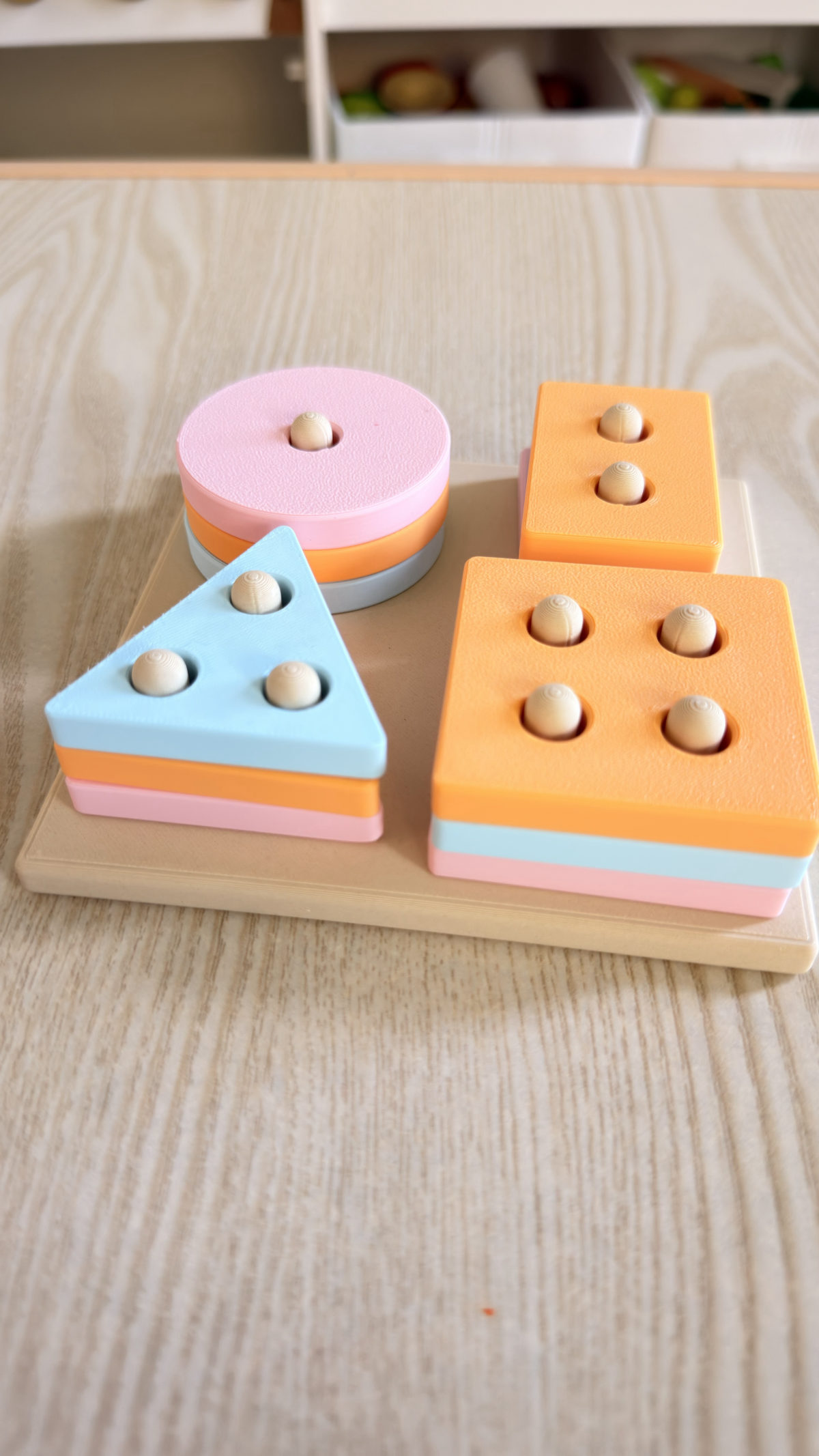
At three, a child is consolidating the motor control to line holes up on vertical pegs, and beginning to link quantities (one, two, three, four) to shapes. At four and five, the same board becomes a way to build colour patterns and race the clock.
- Dimensions
- 4.72 × 4.72 × 1.34 in
- Weight
- 0.32 lbs
Description
Main focus: early logical-mathematical reasoning, spatial orientation and visuomotor coordination.
Skills it really builds
- Subitizing and first quantification: the child learns to recognize quantities on sight (one, two, three, four holes) and tie them to the geometry of the piece, without counting item by item on every attempt.
- Motor planning and spatial rotation (praxis): to seat a two, three or four-hole piece, the child has to turn it in space until the holes line up with the fixed pegs.
- Bimanual coordination and finger dissociation: one hand steadies the base while the other manipulates the block and places it precisely.
Safety & quality in every detail
Playtime should be imaginative and completely safe, so every piece is made with the same care for little hands.
- 100% non-toxic material: plant-based PLA, derived from cornstarch, so it is eco-friendly and safe for toddlers.
- Embedded safety magnets: the magnets are sealed inside the toy as it prints, so nothing can come loose during play.
- Ergonomic design: smooth edges and a size that fits comfortably in little hands, meeting safety standards for ages 3 and up.
Care & maintenance
- How to clean: wipe it with a damp cloth and a little mild soap.
- What to avoid: never soak it, wash it under running water, or use harsh chemicals or alcohol. It is a thermoplastic, so keep it away from high heat, like prolonged direct sunlight or the dishwasher.
The beauty of 3D printing
Each toy is made individually, layer by layer, so fine horizontal lines and small textured points on the surface are a natural part of the process, tiny ridges where the printer starts and stops each layer.
They are not defects. They are the signature of 3D printing, much like wood grain or the marks on handmade pottery, and they show the craftsmanship behind every piece we make.